Describing the Enterprise Architecture
Business capabilities are implemented by components of the enterprise architecture. Technical and functional architectures may be described using different formalisms:
• by a business function architecture environment, which contains the elements that define the enterprise model (operating model) for the current stage.
• the definition of the ecosystem of the enterprise (interactions with partners),
• the business function architectures,
• the business functions.
• By the solution building block environments that depend on product licenses used, for example, with HOPEX IT Architecture : the environment for Logical Application Systems, the environment for Application Systems, the environment for Resource Architectures, etc.
 For more details, see Describing an Enterprise Architecture.
Describing the business architecture environment
 A business architecture environment represents the relationships of a business functional area with its partners.
In this example, the business function architecture environment of company is made up of the historical business function architecture and its interactions with external partners: clients and suppliers. You can see in the diagram that delivery is outsourced to a third party deliver partner.
An application deployment architecture describes one possible deployment configuration of an application. It contains the deployment architectures to be hosted, recommends hosting architectures and identifies required communication techniques (communication protocols and port numbers) they use to communicate with each other. . An application may have several deployment architectures (E.g.: autonomous installation, horizontal or vertical deployment, etc.)A business partner designates a third-party who is in relation with the enterprise within the framework of a given business architecture environment. Examples: private sector client, regulatory organization, supplier.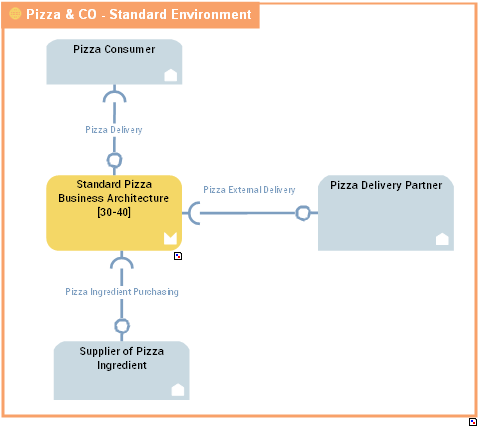
Communications between the objects are represented by interactions service.
A Service Interaction represents an interaction for service purpose between entities in a specific context inside or outside a company. These entities can be enterprise org-units, applications, activities or processes, as well as external org-units. The content of this interaction is described in a service interface.Describing a business functional area
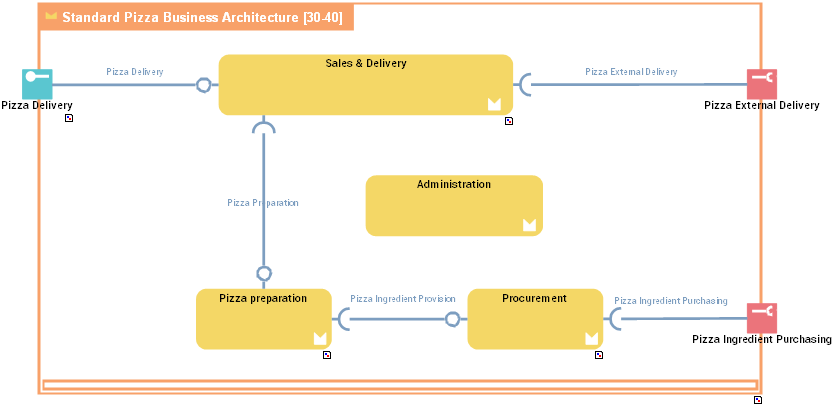
An application deployment architecture describes one possible deployment configuration of an application. It contains the deployment architectures to be hosted, recommends hosting architectures and identifies required communication techniques (communication protocols and port numbers) they use to communicate with each other. . An application may have several deployment architectures (E.g.: autonomous installation, horizontal or vertical deployment, etc.)In this example, the history functional area is based on the business functional areas for selling, delivering and command.
Defining the business skills and functionalities associated with business functions
To be able to subsequently check that each business capability is implemented by a suitable business function, you must define the required business skills and functionalities, for each business function.
A technology capability is the ability to deliver a technology service which is required by a technology artifact or an application.For more details on skills and the business capability functionalities, see Defining business skills and functionalities associated with capabilities.