Normalization Rules
Normal forms are rules that are designed to avoid modeling errors. Currently, there are six or seven normal forms. We will discuss the first three.
First Normal Form
|
Rule: The value of an attribute is uniquely set when the object(s) concerned are known.
|
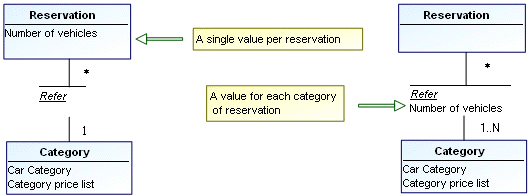
If the number of vehicles is an attribute of the “Reservation” entity, you can only indicate the total number of vehicles for a reservation. You must therefore make one reservation per category of rental vehicle (multiplicity of 1).
If the number of vehicles is an attribute of the association, you can specify the number of vehicles reserved for each category in the association. You can therefore make a single reservation for several categories of vehicles (multiplicity of 1..N).
Second Normal Form
Rule: The value of an association attribute is set only when all the entities concerned are known. |
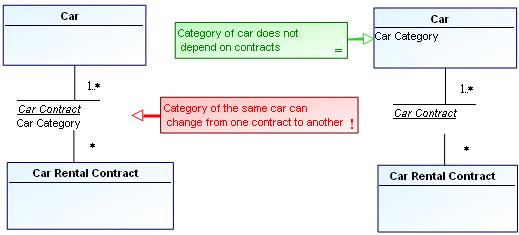
If the car category is an attribute of the “Car Contract” association, this assumes that the car category may change from one contract to the next, which would not be very honest.
If the car category is to be independent of the contract, it must be an attribute of the “Car” entity.
Third Normal Form
Rule: An attribute depends directly and uniquely on the entity it describes. |
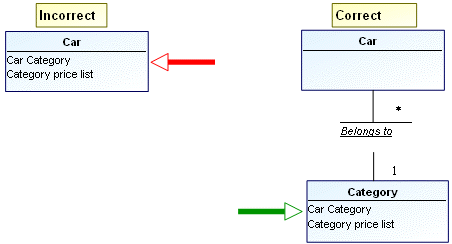
If the “Category Price List” is an attribute of the “Car” entity, this indicates that two cars in the same category can have a different “Category Price List”.
To avoid this, we need to create a “Category” entity that contains the price list.
 This rule is used to reveal concepts that were not found during the first draft of the data diagram.