Modifying a Shape Fill
You can:
• fill your shapes with a solid color
• apply a color gradient or a pattern
• apply transparency
Defining the color of a shape
To define the color of a shape:
1. Right-click the shape and select Colors and borders.
2. In the Fill section, in the Color field, click the arrow.
 Quick access: Select the shape and in the diagram shape editing bar, click Fill color
  .
.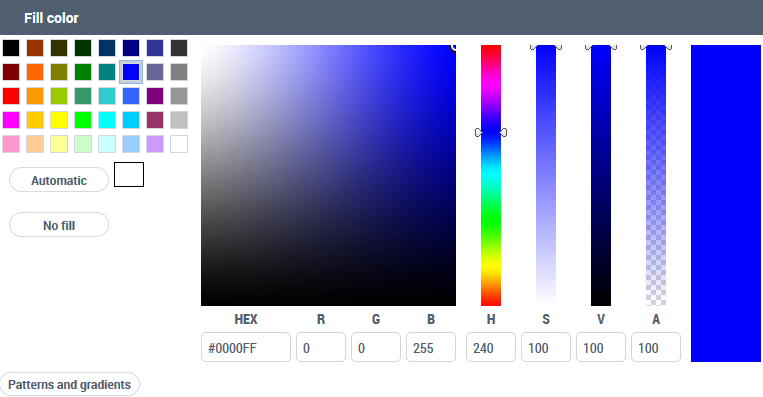
3. Select one of the suggested colors.
When elements cover other elements, the No fill color enables to view elements in the background.4. (If needed) Adjust the color with the range sliders to the right, or with the hexadecimal, RGB (Red, Green, Blue) or HSV (Hue, Saturation, Lightness) values.
5. (If needed) Add a pattern or a color scale.
Defining a color gradient or a pattern to a shape
You can define two colors to a shape and apply:
• a color scale
The shape color gradually moves from one color to the other one.
• a pattern
To apply a color gradient or a pattern to a shape:
1. Right-click the shape and select Colors and borders.
2. In the Fill section, in the Color field, click the arrow.
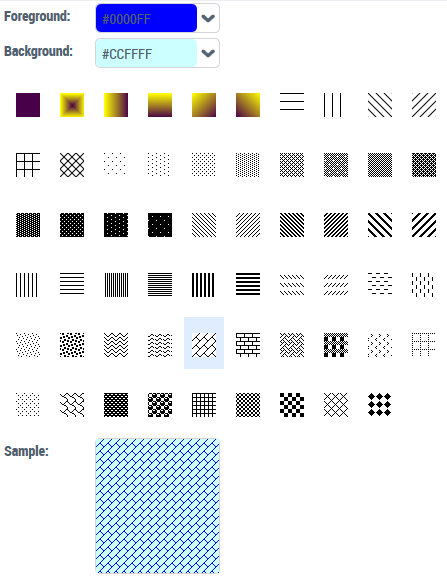
Quick access: Select the shape and in the shape editing bar of the diagram , click Fill color .3. Click Patterns and gradients.
The color of the Foreground field is predefined with the shape color.
4. (If needed) Modify the color of the Foreground field.
5. In the Background field, set the color of the background (or second color for a pattern with a color gradient).
6. Select a pattern.
A sample of the rendering is shown.
7. Click OK.
Managing transparency
To apply transparency to a shape:
1. Right-click the shape and select Colors and borders.
2. In the Fill section, in the Transparency field, select or enter a value.
The value indicates the fill transparency level.
E.g.: 0%, by default, indicates that the shape is opaque.