Analyzing the functional coverage of the architecture implemented
The goal of this step, on a strategic level, is to check the suitability between the business capabilities of the enterprise, the functionalities required and the applications that deliver them.
Describing Business Capabilities
 For more details on managing business capabilities with HOPEX IT Architecture, see Describing Business Capabilities with HOPEX IT Architecture.
A business capability defines an expected skill.
 .A business capability is a set of features that can be made available by a system (an enterprise or an automated system).
A business capability map describes what the enterprise is capable of producing for its internal needs or for meeting the needs of its clients. It is thus based on the main business capabilities of its activity at a given moment.
A business capability map is a set of business capabilities with their dependencies that, together, define a framework for an enterprise stage.For example, the standard ability to manage "Operational Activities" is based on the business capabilities to process "Supply", "Sales" and "Complaints", "Order Management" and "Customer Management".
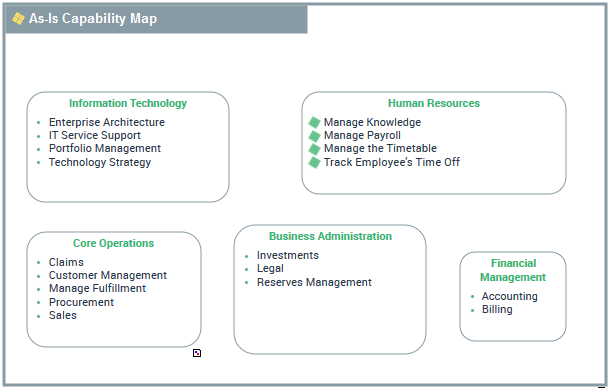
Example of a business capability map
For more details on managing a business capability map, see Describing Business Capabilities with HOPEX IT Architecture.Identifying the functionalities associated with business capabilities
The aim here is to connect the functionalities, which correspond to what is expected to achieve the objectives, to the means of implementation represented by applications or application systems at a conceptual level.
An application system is an assembly of other application systems, applications and end users interacting with application components to implement one or several functions.By constructing the functionality map on the one hand and the application system environment on the other hand, you can check that the functionalities are implemented by application components.
For more details on the logical applications associated with business capabilities, see Describing the fulfillment of a Functionality.HOPEX IT Architecture provides a report that presents the result of the implementation of business capabilities by applications or application systems physical or logical.
For more details on implementation of business capabilities, see Business Capability Breakdown Report.A functionality is an aptitude expected from an equipment.
A technical functionality is a capability expected from an equipment item (hardware or software) to ensure the operation of a technical element or an application.A functionality map describes all the functionalities the enterprise is able to cover for its internal needs or for meeting the needs of its clients.
A technical functionality map is a set of functionalities with their dependencies that, jointly, define the scope of an architecture.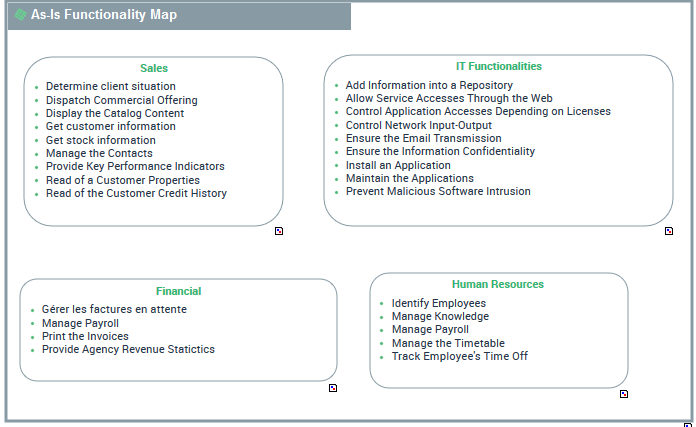
Example of a functionality map
For more details on managing a functionality map, see Describing a Functionality Map with HOPEX IT Architecture.The description of business capabilities and functionalities is particularly interesting if business capabilities are associated with the functionalities that fulfill them.
For more details on this analysis, see Describing Fulfillment of a Business Capability.Identifying the applications associated with functionalities
Applications cover functionalities associated with business capabilities. In HOPEX IT Architecture , a report allows to check the functional coverage of your applications.
For more details on this functional coverage, see Describing Fulfillment of a Business Capability.