Sub-typing (Merise)
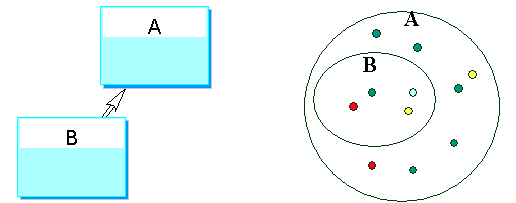
What is sub-type?
An entity B is a sub-type of entity A. This assumes that all instances of entity B are also instances of entity A. In other words, B is a subset of A.
Example A: Person, B: Bostonian.
B being a subset of A, the instances of entity B "inherit" the characteristics of those in entity A.
It is therefore unnecessary to redescribe for entity B:
• its properties
• Its associations
Example
The "Large Client" entity, representing clients with a 12-month revenue exceeding $1 million, can be a subtype of the Client entity (origin).
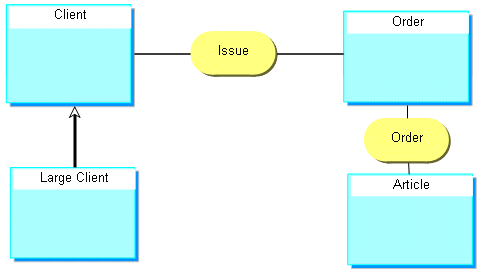
A sub-type inherits all properties, associations, roles and constraints of its super-type, but it can also have properties, associations, roles or constraints that its super-type does not have.
In the above example, the properties, associations, roles and constraints specified for "Client" are also valid for "Large Client".
Multiple Subtypes
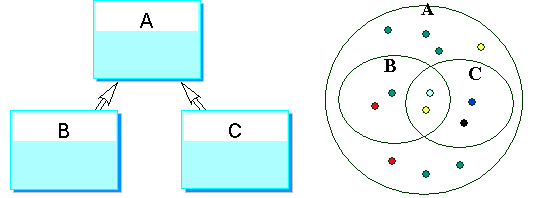
Several sub-types of the same entity
• are not necessarily exclusive.
• do not necessarily partition the type.
Advantages of sub-types
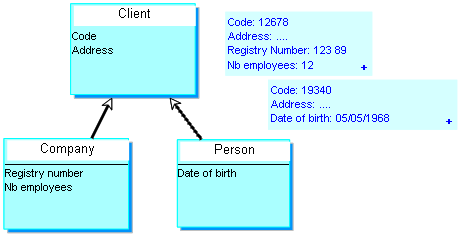
A sub-type entity can have specific properties. These only have meaning for that particular sub-type. In the above example:
• "Registry number" and "number of employees" only have meaning for a "company".
• "Date of birth" is a characteristic of a "person", not a "company".
 An entity B is a sub-type of an entity A, if B represents a subset of A and the instances of entity B inherit the descriptions of those of entity A and if they have specific descriptive elements.
 The Sub-Type link is represented graphically by a double arrow.
A subtype entity can also have specific associations.
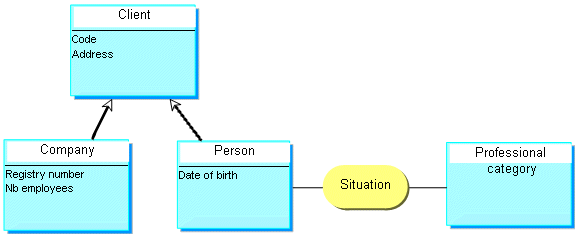
A "person" falls into a "socio-professional group": “manager”, “employee”, “shopkeeper”, “grower”, etc. This classification makes no sense for a “company”. There is also a classification for companies, but this differs from the one for persons.