Managing Ideas with HOPEX Digital Transformation Desktop
 An idea is a potential modification project which could be carried out to the architectural landscape in order to improve the enterprise capabilities. Its impact and scope can be defined through Idea Subjects; Idea subjects may concern capabilities and / or items of the architectural landscape. Ideas may also be freely defined and not related to an identified architectural artifact within the architecture landscape (e.g. disruptive ideas do not necessarily relate to a Solution Building Block or Capability).
The Ideas can be submitted freely or collected within the context of an ideation campaign on the initiative of the innovation manager (descending approach) or freely submitted at any time (ascending approach); in both cases the ideas are added in the “Ideation & Project Funnel”.
An ideation campaign is a way of organizing the collection of stakeholder ideas on a particular subject.The ideas are examined by the innovation manager; they can give rise to project demands, in the context of the “Ideation & Project Funnel”, and the ideas can then be assessed within the context of the demands management process.
You can link an idea to similar ideas and specify where appropriate the duplicates.
With HOPEX Ideation Management, the ideation process is broken down into three main parts:
• Idea creation; at any time, users can submit an idea to the innovation manager.

• Assessing the idea;
• Approving or rejecting the idea.
To use the functionalities with HOPEX Digital Transformation Desktop:
1. Click the navigation menu, then General.
2. In the navigation pane, select Idea Management.
A list of tiles is proposed to help you to create and classify your Ideas.
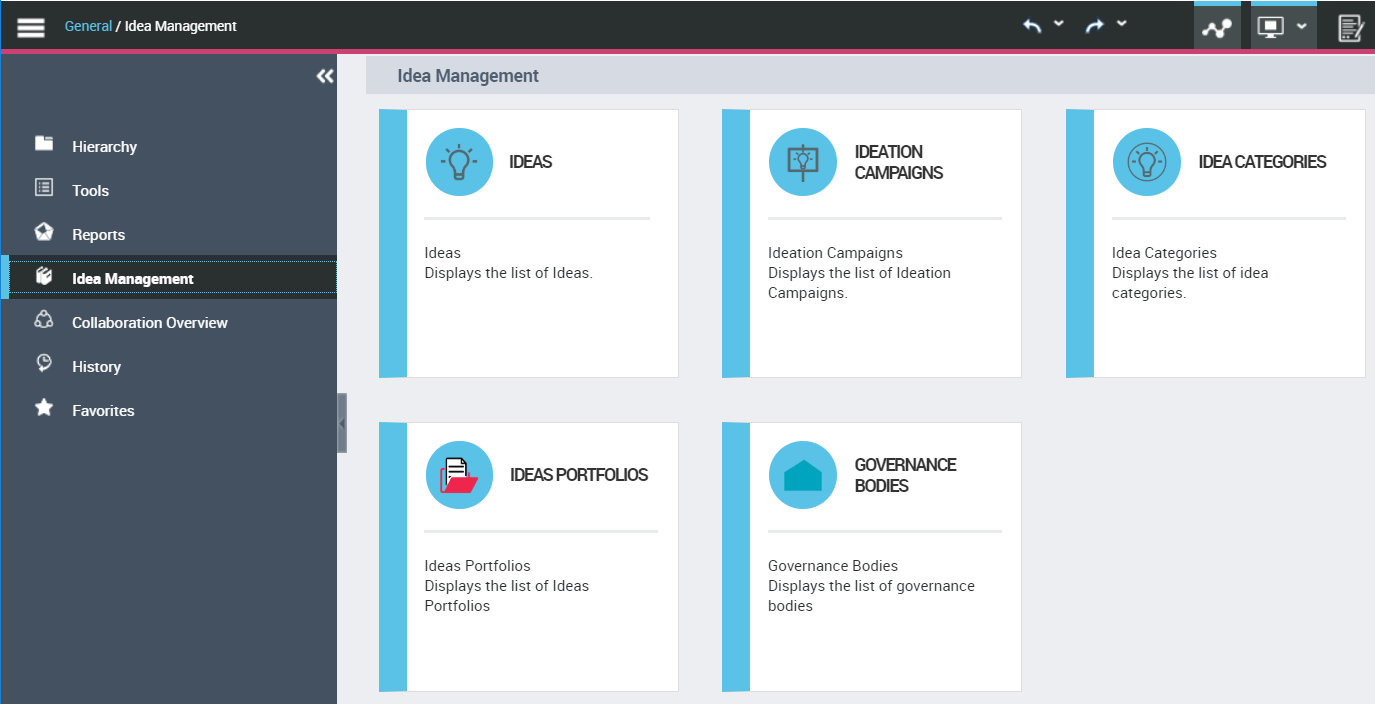
3. Click Ideas tiles to access and manage your ideas.
For more information on managing Ideation, see "Submitting and evaluating ideas", page 585.