Implementing the TOGAF 9 ADM in HOPEX
HOPEX Suite for TOGAF is the implementation of the TOGAF 9 framework in the HOPEX Modeling Suite.
This application assists you in creating projects via:
• The ADM method formalization
• The initialization of TOGAF 9 projects
• A continuous guide at the different stages of the project
• The ability to filter TOGAF phases, according to the current user role.
The TOGAF 9 ADM phases are as follows:
• The Preliminary Phase: this phase describes the preparation and initiation activities required for preparing to meet the business directive for a new enterprise architecture. This includes the definition of an Organization-Specific Architecture framework and the definition of principles.
• Phase A: Architecture Vision: this phase describes the initial phase of an architecture development cycle. It includes information about defining the scope, identifying the stakeholders, creating the Architecture Vision and obtaining approvals.
• Phase B: Business Architecture: this phase describes the development of a Business Architecture to support an Architecture Vision that has been agreed on.
• Phase C: Information Systems Architectures: this phase describes the development of Information Systems Architectures for an architecture project, which includes the development of Data and Application Architectures.
• Phase D: Technology Architecture: this phase describes the development of the Technology Architecture for an architecture project.
• Phase E: Opportunities & Solutions: this phase conducts initial implementation planning and the identification of deliverables for the architecture defined in the previous phases.
• Phase F: Migration Planning: this phase addresses the formulation of a set of detailed sequence of transition architectures with a supporting Implementation and Migration Plan.
• Phase G: Implementation Governance: this phase provides an architectural oversight of the implementation.
• Phase H: Architecture Change Management: this phase establishes procedures for managing changes to the new architecture.
• Requirements Management: this phase examines the process of managing architecture requirements throughout the ADM.
MEGA's implementation of the TOGAF 9 ADM extends over two different approaches to using the HOPEX Suite for TOGAF tool:
• As a standard TOGAF implementation for using the TOGAF application as a stand-alone tool.
• As an extended MEGA implementation that supports ADM-guided projects combined with the HOPEX metamodel and diagrams.
Standard TOGAF implementation
With this approach, the metamodel provided to support the ADM is strictly and fully compliant with the entire architecture content framework. All concepts, properties and associations can be accessed with their native names. The HOPEX Suite for TOGAF application can be used as a stand-alone tool, with no need for additional applications to start architecture projects. TOGAF concepts can be used with their native names.
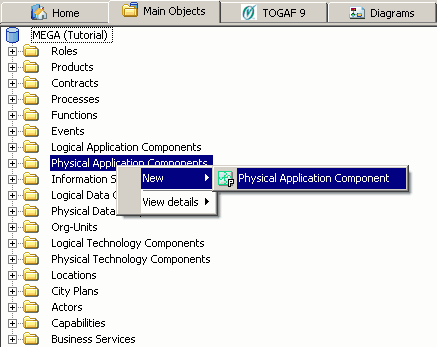
The HOPEX Suite for TOGAF application is provided with a set of reports that are generated from the created TOGAF concepts.
New diagrams have also been delivered to support the TOGAF metamodel. These new diagrams supply the content architecture framework, therefore, allowing the creation of TOGAF concepts and associations.
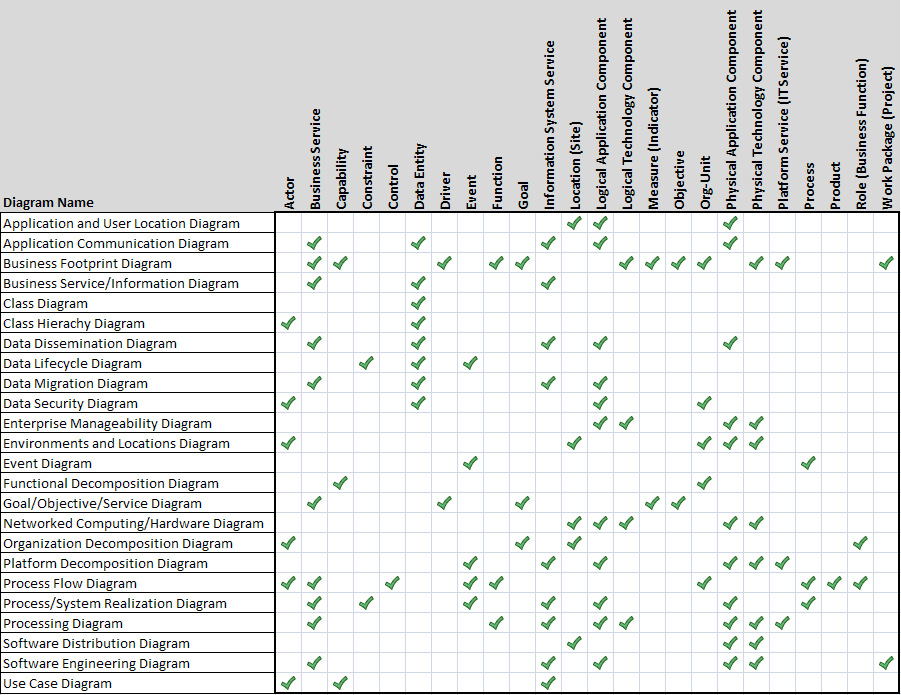
List of diagrams and concepts proposed for the standard implementation of TOGAF
Extended TOGAF Implementation
With this approach, the ADM method is configured for using HOPEX templates to implement expected deliverables. The proposed templates are dependent on the availability of additional products, such as HOPEX Business Process Analysis, HOPEX Architecture and HOPEX Planning.
This approach relies on the complete HOPEX metamodel which includes the HOPEX Business Process Analysis and HOPEX Architecture metamodels. To be consistent, the diagrams proposed in this context are those supplied by the additional tools.
Filtering Native TOGAF Deliverables
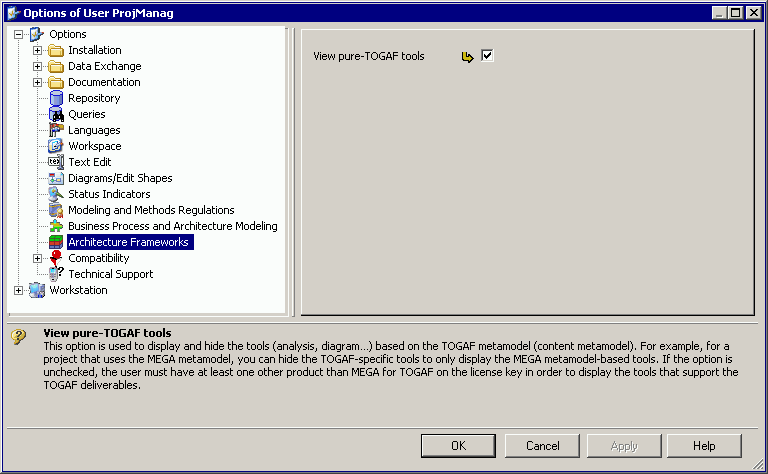
The means of providing native TOGAF deliverables, such as document templates, diagrams, reports, etc. are provided by the HOPEX Suite for TOGAF application. As such, when this application is combined with another complementary application of the HOPEX Modeling Suite, the TOGAF tools as well as the extended set of tools from the other applications are visible. To allow users to filter the type of tools visible, an option has been added. By default, this option is checked, allowing users to only have access to TOGAF tools.