Describing the enterprise capabilty for creating value
Describing value streams
A value stream is represented by a sequencing of value creation steps managed by the business functions of the architecture.
 A value stream is an end-to-end collection of Value Stages that creates an outcome for a customer, who may be the ultimate customer or an internal end-user of the value stream.A value stage is a distinct, identifiable phase or step within a value stream that has a unique entrance criteria, exit criteria, and identifiable participating business function or business functional area.
The following diagram presents an example of a value stream:
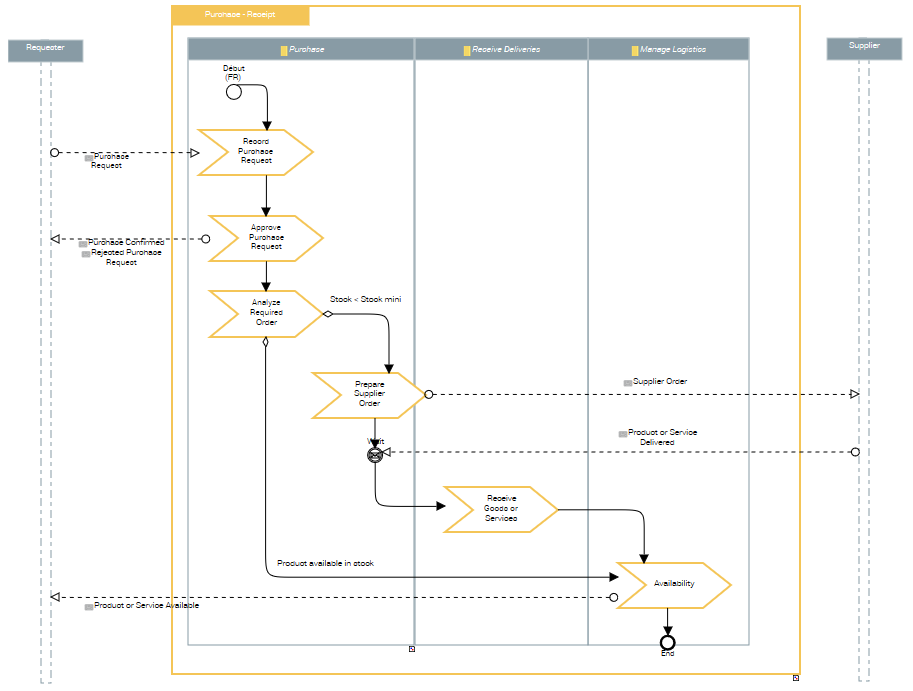
 For more details on value streams, see Describing value streams.
Describing the Architecture of Business Capabilities
Building the business capability map
A business capability map describes what the enterprise is capable of producing for its internal needs or for meeting the needs of its clients.
A business capability map is a set of business capabilities with their dependencies that, together, define a framework for an enterprise stage..A business capability is a set of features that can be made available by a system (an enterprise or an automated system).The business capability map thus presents the business capabilities of the highest level for one of the transformation stages.
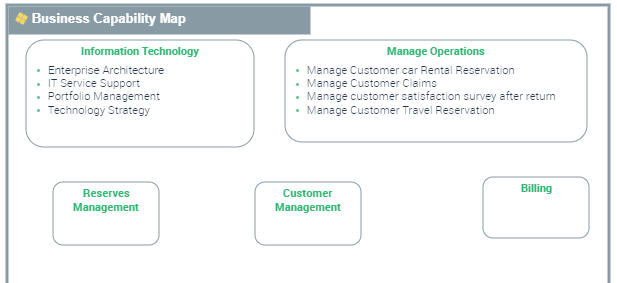 For more details on business capability map diagrams, see Creating a business capability map diagram.
Describing the business capability breakdown
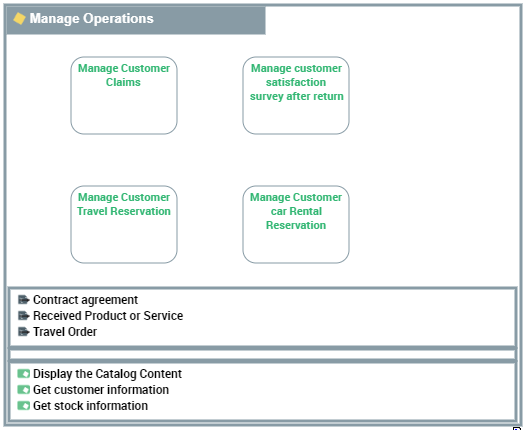
Business capabilities are then described more precisely to identify:
• a more detailed granularity capability breakdown;
• the expected effects of the capability;
• the business skills or functionalities required for each of them;
• the dependencies between capabilities (expected effect of one dependent from the result of the other).
For example, the business capability that consists of managing operations is broken down into a number of business capabilities: “Handle customer complaints”, “Manage reservations”.
Defining the business skills and functionalities associated with business capabilities
To be able to then check that each business capability is correctly implemented by suitable solution building block, you must define the required business skills and functionalities.
A functionality is a service required by an org-unit in order to perform its work. This functionality is generally necessary within an activity in order to execute a specific operation. If it is a software functionality, it can be provided by an application.For more details on skills and the business capability functionalities, see Defining the business skills and functionalities associated with business capabilities.Describing business capability implementation by the business functions
This involves connecting the business capability, which corresponds to what we know how to do or what we want to do and which represents the goal to be achieved, to a way of achieving what is represented by a business function or a business functional area at a conceptual level, that is, upstream of organizational and technical choices.
An application technical architecture describes one of the configurations possible for application deployment. It describes how the different technical areas of the application are connected to each other and the technologies and the communication protocols that they use. An application can have a number of possible technical architectures (E.g.: autonomous installation, horizontal or vertical deployment, etc.)This business functional area will itself carry the value processes whose steps will require its business function components.
Construction of the business capability map on the one hand and the business architecture environment on the other hand is used to check that the business capabilities are implemented by the business functions.
For more details on the businesses associated with business capabilities, see Creating Fulfillment of a Business capability.HOPEX IT Business Management provides a report that presents the result of the implementation of business capabilities by business functions.
For more details on the breakdown of business capabilities, see Creating Fulfillment of a Business capability.