What is a generalization?
 A generalization represents an inheritance relationship between a general entity and a more specific entity. The specific entity is fully consistent with the general entity and inherits its characteristics and behavior. It can however include additional attributes or associations. Any object of the specific entity is also a component of the general entity.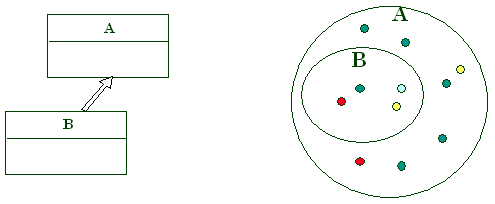
Entity A is a generalization of entity B. This implies that all objects in entity B are also objects in entity A. In other words, B is a subset of A. B is then the sub-entity, and A the super-entity.
Example:
A: Person, B: Bostonian.
B being a subset of A, the instances of entity B "inherit" the characteristics of those in entity A.
It is therefore unnecessary to redescribe for entity B:
• Its attributes
• Its associations
Example:
The “Large Client” entity, representing clients with a 12-month revenue exceeding $1 million, can be a specialization of the Client entity (origin).
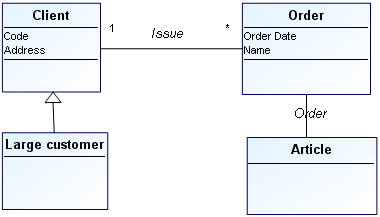
In the above example, the associations and attributes specified for “Client” are also valid for “Large client”.
Other examples of generalizations:
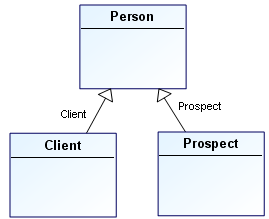
"prospect" and "client" are two sub-entities of "person".
"export order" is a sub-entity of the "order" entity.
"Individual person" and "corporate person" are two sub-entities of the "person" entity.
"polygon", "ellipse" and "circle" are sub-entities of the "shape" entity.
"oak", "elm" and "birch" are sub-entities of the "tree" entity.
"motor vehicle", "off-road vehicle" and "amphibious vehicle" are sub-entities of the "vehicle" entity.
"truck" is a sub-entity of the "motor vehicle" entity.