Describing Interaction in a Resource Architecture Diagram
In a resource architecture diagram, Interactions enable representation of exchanges between organizational entities.
 An interaction represents a contract established in a specific context between autonomous entities that are internal or external to an enterprise. These entities can be enterprise org-units, applications, activities or processes, as well as external org-units. The content of this contract is described by an exchange contract.
Exchange terms are defined by an Exchange contract assigned to the interaction.
An exchange contract is a model of a contract between organizational entities. This contract is described by exchanges between an initiator role and one or several contributor roles.You can define interactions between:
• Two components of resource use type to represent exchanges between these entities,
• A component of resource use type and a physical asset to represent terms of use of the equipment resource by the organizational resource. For example, you can represent that software test platform use is arranged by booking.
• Two components of physical asset type to represent terms of use of a resource by another in the context of the modeled resource architecture. For example, terms of use of replacement equipment (spare parts) depends on priority level of the organization requesting this.
• A service point and one or several resource use type components to represent implementation of the service within the resource architecture,
• A component of resource use type and a request point to represent that the entity calls a resource of an external organization.
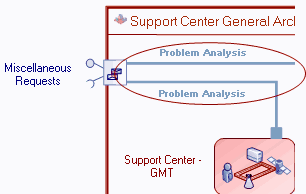
In the example of the general support system, two interactions are used to indicate that support services are handled by one center or another depending on time slot. The two interactions are executed according to the same exchange contract.
For more details on interaction management terms, see Managing Interactions.