Consistency Rules
Definition of concepts
Consistency Rules
A rule applies to a HOPEX repository object and defines a check on this object.
There are several levels of rule:
• Suggestion: rule it is advisable to observe, but not a requirement.
Non-respect of the rule is indicated in the rules application report but does not produce a warning.
• Recommendation: important rule.
Non-respect of the rule produces a warning.
• Requirement: mandatory rule.
Non-respect of this rule produces an error and is a source of blocking.
 For more details on the rules, see Creating Consistency Checks.
Regulations
A regulation enables classification of rules according to a specific context or domain. It can contain not only a set of rules but also sub-regulations.
You can define an active regulation, permanently visible on objects concerned.
For example, if you activate the "Process Modeling Regulation" regulation, there is an automatic check on the business processes, organizational processes, activities, org-units, operations and conditions that you create and handle.
You can also apply another regulation temporarily on an object.
Active regulation permanent check
An active regulation is a reference regulation, defined as such so that you can permanently check the conformity of objects that you create with rules to be respected.
Defining an active regulation (Windows Front-End)
You must carry out this operation in HOPEX Windows Front-End.
To define an active regulation:
1. From the HOPEX menu bar, select Tools > Options.
2. Select Modeling and Methods Regulations.
3. In the Active modeling regulation field, click  .
.
.4. In the dialog box that appears, select the regulation to be applied and click OK.
You can consult results linked to this regulation at any time. They appear in the properties dialog boxes of the objects concerned. You can also display them in diagrams and navigators with status indicators showing objects that are not validated with respect to the regulation.
Results of checks on objects
When an active regulation exists, results appear in the properties dialog boxes of objects to which the regulation is applied.
To consult results:
1. Open the object properties.
2. Select the General tab, Rules Application subtab.
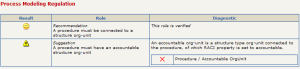
You obtain the name of the regulation, followed by a table containing the names of rules in the regulation, their result for the checked object and the diagnostic.
Check results appear in the form of an icon.
Each icon relates to a regulation rule:
 | Rule is respected. |
 | Rule is "Suggestion" type and is not respected. |
 | Rule is "Recommendation" type and is not respected. |
 | Rule is "Error" type and is not respected. |
If the “Error on execution” message appears, it means the rule was not correctly implemented. In this case, consult your administrator.
Results in diagrams and the navigator
You can also display results in the diagram that contains the object. In this case, a status indicator appears alongside the checked object if an error or omission is to be reported.
In the same way you can display check results in the navigator.
 Since the diagram displays no result by default, the lack of indicator means that no error has been detected, on condition that you had activated the rule and selected the result display option.
 To display rule results in the diagram:
1. In the HOPEX menu bar:
• (Windows Front-End) Select Tools > Options.
• (Web Front-End) Click Main Menu > Settings > Options.
2. Select the Modeling and Methods Regulations folder.
3. Select the option "Apply active regulation in diagrams".
To view results specific to a diagram object:
 Click the icon that appears under the checked object.
A dialog box opens, detailing rules applied to the object.
Regulation specific check
When you run a check on an object, a dialog box asks you to select which regulation you wish to apply. This is a temporary check, independent of any which may be active on the object from another source The specific check relates not only to the selected object but also to objects connected to it.
Occasional checks on objects
To apply a specific regulation to an object:
1. Right-click the object concerned and select Check > Regulation with propagation.
The effect of this command is to check the object and its connected objects. So in the case of an organizational process, you obtain results not only on the process itself but also on objects contained in this process, such as org-units, operations and messages.The list of regulations appears: This list comprises regulations that can be applied to the object concerned.
The regulations administrator can apply a regulation to the object other than one of those defined by default. If an active regulation is defined and applies to the object in question, it appears in the list and is selected by default.
2. Select the regulation you wish to apply and click OK.
A report in the form of an HTML page appears.
Occasional checks in a diagram
To specifically check objects in a diagram:
1. InWindows Front-End, open a diagram.
2. Select Diagram Check > Regulation with Propagation.
3. Select the regulation that you want to apply to the diagram.
4. Click OK.
A report appears. It contains results of the check on diagram objects.
Check results
Check results appear in an HTML report. This report indicates the regulation applied and lists the objects concerned.
The icon that appears before an object corresponds to the result not of a rule but of all rules applied to the object.
The result icon that will appear depends on the level of rules that have not been respected:
| All rules respected. |
| At least one "Suggestion" type rule is not respected. No "Recommendation" or "Error" type rule to be reported. |
| At least one "Recommendation" type rule is not respected. No "Error" type rule to be reported. |
| At least one "Error" type rule is not respected. |
The link Rules Application Detail allows you to consult detail of these rules.