|
Concept Name
|
Notation
|
Comment
|
|
Association
|
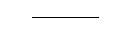 |
Association models a relationship between objects that is not covered by another, more specific relationship.
note: this has only been implemented between data objects in the Information Structure Viewpoint.
|
|
Access
|
 |
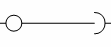
The access relationship models the access of behavioral concepts to business or data objects.
|
|
Used by
|
 |
The used by relationship models the use of services by processes, functions, or interactions and the access to interfaces by roles, components, or collaborations.
|
|
Realization
|
 |
The realization relationship links a logical entity with a more concrete entity that realizes it.
|
|
Assignment
|
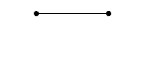 |
The assignment relationship links units of behavior with active elements (e.g., roles, components) that perform them, or roles with actors that fulfill them.
|
|
Aggregation
|
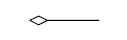 |
The aggregation relationship indicates that an object groups a number of other objects.
|
|
Composition
|
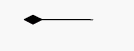 |
The composition relationship indicates that an object consists of a number of other objects.
|