HOPEX IT Architecture : Virtualization and Clustering Modeling : The Resource Architecture Metamodel
   
The Resource Architecture Metamodel
This section explores the main concepts of the resource architecture metamodel introduced in the MEGA 2009 SP2. The following table lists some concepts of these metamodel. For more explanations, refer to the MEGA Architecture guide.
Concept
Comment
Resource Architecture
A resource architecture is a combination of physical assets and organization configured to provide a capability.
Artifact
An artifact is any element in the physical domain that is not an application or an organizational element (where organizational includes people).
An Artifact can represent a physical system, sub-system, platform, component or simply a physical item that has specific attributes.
Application
An application is a set of software tools as seen from the software development viewpoint.
Org-Unit
An org-unit represents a person or a group of persons that intervenes in the enterprise business processes or information system. An org-unit can be internal or external to the enterprise.
- An internal org-unit is an organizational element of the enterprise structure such as a department, a service, or a workstation. An internal org-unit is defined based on how detailed you require your view of the enterprise to be (cf org-unit-type). Example: financial management, sales management, marketing department, account manager.
- An external entity is an organization that exchanges flows with the enterprise. Example: Customer, Supplier, Government Office.
 
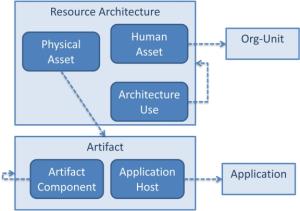
These four concepts help to model resource architectures that describe solutions designed to support a given capability. An architecture design explains how components are grouped together and communicate each other. The designed solutions include both the technical aspect (equipment and software) and the human resources. In this context, the architecture is composed of items exposed above and is more focused on the infrastructure part so only the artifact/application part is detailed.
In order to enable the description of interaction in the context of a solution (resource architecture) each inserted item is represented by an intermediate concept referencing it. The figure hereafter shows these intermediate items. This mechanism separates the interactions that equipments or applications perform in more than one context (refer to the “Artifact Type and Instance” article for more details on this topic).
Figure 1: The Concepts Introduced for the Modeling of Technical Architecture Items.