Exchange Contract and Interaction Operation Example
An Interaction represents the exchange of information between architecture components.

An interaction represents a contract established in a specific context between autonomous entities that are internal or external to an enterprise. These entities can be enterprise org-units, applications, activities or processes, as well as external org-units. The content of this contract is described by an exchange contract.
Content of an interaction is described by an exchange contract.
An exchange contract is a model of a contract between organizational entities. This contract is described by exchanges between an initiator role and one or several contributor roles.
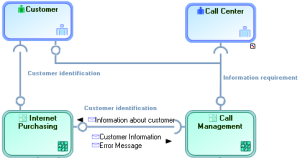
In the "Purchasing Requests Processing" application system structure diagram, two interactions are used.
Interactions in the "Purchasing Requests Processing" application system structure diagram
Customers can place orders through an Internet application or a call center, which itself uses the Internet application to obtain the customer identification service.
A customer passing via the call center can make other requests in addition to orders.
Exchange contract diagram (BPMN)
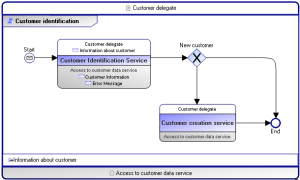
The exchange contract diagram associated with the customer identification exchange contract describes, in BPMN formalism, the operations executed.
Exchange Contract Diagram (BPMN) "Customer Identification"
Customer identification protocol starts with a customer identification step. If the customer is found the exchange contract returns customer information, if not, a customer creation exchange contract is activated.
Progress steps are represented by exchange uses.
Exchange diagram
With the MEGA Service Design option, an exchange use is associated with an exchange.
An exchange use represents the usage of an exchange in another exchange contract.
An exchange specifies message flow exchanges between two participants.
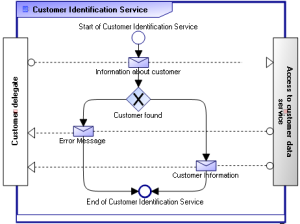
An exchange is described by an exchange diagram presenting the sequence flow of messages exchanged.
An exchange specifies message flow exchanges between two participants.
"Customer Identification Service" Exchange Diagram
The customer identification service protocol begins by sending information enabling identification of the customer. An error message appears if the customer is not found, otherwise customer information is sent (customer identification, status of orders, etc.).
Advanced communication exchange contract example
With the MEGA Service Design option, an exchange contract is described by a sequence flow of steps which are represented:
• by exchange contract uses
• by exchange uses
An exchange contract is a model of a contract between organizational entities. This contract is described by exchanges between an initiator role and one or several contributor roles.
An exchange use represents the usage of an exchange in another exchange contract.
The exchange contract roles, presented at the border of the frame, represent participants:
• customer/supplier, or
• sender/recipient
An exchange can be described by involving more than two participants. In this case, one role is the initiator of the exchange contract and the others are contributors.
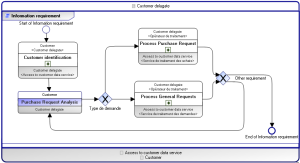
"Information Requirement" Exchange Contract Diagram (BPMN)
The "Information Request" exchange contract is used by the call center to take account of a customer request online. There are therefore three participants in this exchange contract: the customer, the IT applications and the customer representative who is the effective requester of the service (in this case the call center).
This exchange contract consists of identifying the customer, then analyzing the request. The request is then processed as a purchase request or as another request if it is an information request for example.