Control Identification
This report presents the distribution of controls according to several criteria:
• by process

A business process represents a system that offers products or services to an internal or external client of the company or organization. At the higher levels, a business process represents a structure and a categorization of the business. It can be broken down into other processes. The link with organizational processes will describe the real implementation of the business process in the organization. A business process can also be detailed by a functional view.
• by control type

A control type allows the classification of controls implemented in a company in accordance with regulatory or domain specific standards (Cobit, etc.).
• by entity
An entity can be internal or external to the enterprise: an internal entity represents an element in the organization of the enterprise such as a department, service or a workstation. It is defined at a level depending on the degree of detail to be provided on the organization (see org-unit type). Example: financial management, sales management, marketing department, account manager. An external entity represents an organization that exchanges flows with the enterprise, Example: customer, supplier, government office.
• by objective
An objective is a goal that a company or organization wants to achieve, or is the target set by a process or an operation. An objective allows you to highlight the features in a process or operation that require improvement.
• by regulatory framework
A regulation or regulatory framework is a set of directives, compulsory or not, defined by a government in a law, by standard bodies as "best practices" or as an internal policy in an organization.
Access path
Reports > IT Compliance > Control Identification
Parameters
This consists of selecting the controls that will be presented in specifying elements that define their scope.
• control types
• entities
• processes
• objectives
|
Parameters
|
Parameter type
|
Constraints
|
|
Begin Date
|
date
|
Assessment selection criterion Not mandatory.
|
|
End date
|
date
|
Assessment selection criterion; set to current date.
|
|
Scope control type
|
control type
|
Control selection criterion. Not mandatory.
|
|
Scope entities
|
entity
|
Control selection criterion. Not mandatory.
|
|
Scope processes
|
process
|
Control selection criterion. Not mandatory.
|
|
Scope objectives
|
objectives
|
Control selection criterion. Not mandatory.
|
Result
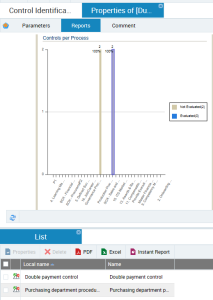
The report presents the distribution of controls in the form of a stacked bar chart. The distribution criteria are as follows:
• Distribution by process
• Distribution by control type
• Distribution by entity
• Distribution by objective
• Distribution by status
• Distribution by regulatory framework
Example
The bar chart below shows the number of controls (evaluated or not evaluated) by regulation.
When you click on a bar chart, the controls in question appear in a list at the bottom of the page.