Links Between Concepts
To define semantics of a concept, HOPEX Information Architecture allows you to draw several types of link between concepts: definition links or dependency links.
Definition links
Definition links enable characterization of a concept.
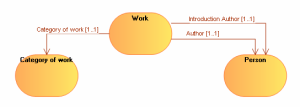
For example, a work is defined by its work category (literary or musical), its author, the author of its preface.
With HOPEX Information Architecture, a definition link is described by a Concept Structural Component, which can be associated with a term.

A concept structural component enables representation of a dependency relationship between two concepts. This relationship is directional.
Dependency links
Certain business concepts are versions of other concepts; they inherit the same structural components of concept.
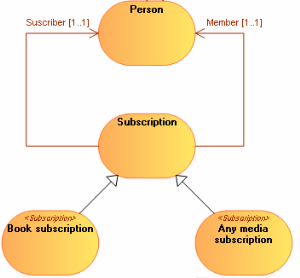
For example, "Subscription" concepts are broken down into "Book Subscription" and "Media Subscription". These two subscription types inherit the links "Subscriber" and "Member" at the level of the "Subscription" concept.
With HOPEX Information Architecture, this relationship is described by a Variation.
A variation describes how a concept can be varied under another form. The variant is an object similar to the varied object, but with properties or relationships that may differ.

For more details on variations, see the
HOPEX Common Features guide, "Handling Repository Objects", "Object Variations".
A Variation can also be created between two Concept Structural Components.
For example, the "Subscriber" is also a "Member".